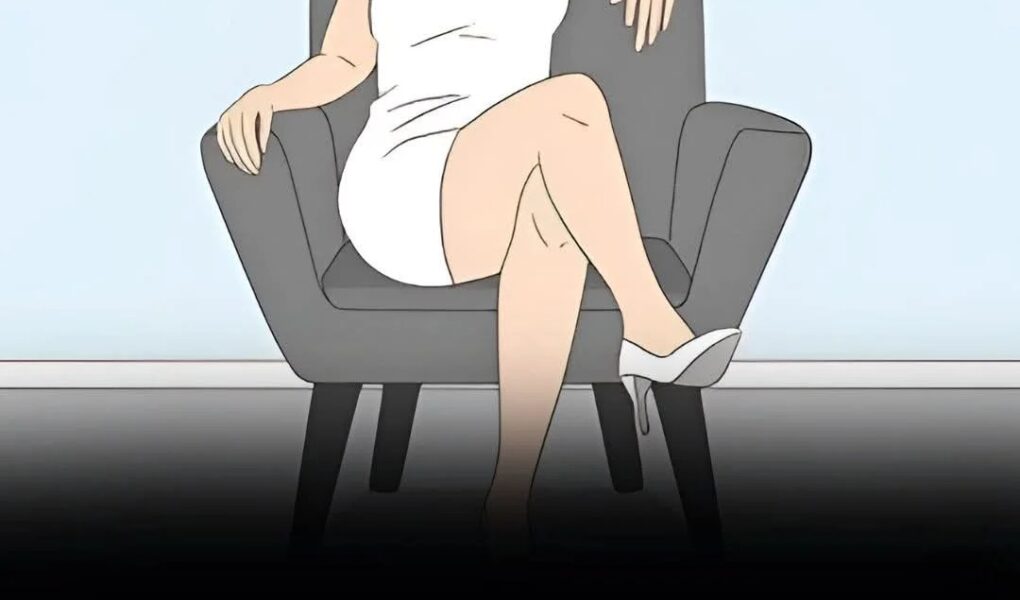
- Dresses
- Skirts
- Certain uniforms
may cross their legs partly for practical reasons involving:
- Comfort
- Coverage
- Modesty
- Habit
Because fashion historically imposed different expectations on women’s posture and presentation, sitting styles became socially associated with femininity in many societies.
4. Body Language and Psychological Interpretation
Body posture can communicate emotional or social signals, intentionally or unintentionally.
In body language analysis, crossed legs are sometimes interpreted as signs of:
- Relaxation
- Reserve
- Self-protection
- Elegance
- Comfort
However, body language is highly context-dependent.
A person crossing their legs does not automatically mean:
- Nervousness
- Flirtation
- Insecurity
- Confidence
The same gesture can reflect completely different emotions depending on:
- Environment
- Personality
- Mood
- Culture
- Physical comfort
Overinterpreting body language often leads to inaccurate assumptions.
5. Habit and Muscle Memory
Many posture behaviors become deeply habitual.
People often sit the same way repeatedly because:
- The body becomes accustomed to it
- Muscles adapt to familiar positions
- The posture feels psychologically normal
Someone who has crossed their legs while sitting for years may do so automatically without consciously deciding.
6. Social Observation and Mirroring
Humans unconsciously imitate behaviors they observe frequently.
Psychologists refer to this as social modeling or mirroring.
Because women commonly see:
- Family members
- Friends
- Public figures
- Characters in media
sitting with crossed legs, the posture becomes socially normalized and repeated naturally.
This is how many everyday habits spread culturally.
7. Different Cultures View Sitting Postures Differently
Sitting styles vary significantly across cultures.
In some societies:
- Crossing legs is considered elegant
- In others, it may appear disrespectful
- Certain postures may carry gender expectations
- Some cultures prioritize formal posture more strongly
Body language norms are heavily shaped by social context rather than universal meaning.
Can Crossing Legs Affect Health?
Occasionally crossing the legs is generally harmless for most people.
However, sitting in any fixed posture for very long periods may contribute to:
- Muscle stiffness
- Reduced circulation temporarily
- Lower back discomfort
Some studies have explored whether prolonged leg crossing may temporarily affect:
- Blood pressure
- Posture alignment
- Nerve compression
But occasional leg crossing is not considered dangerous for healthy individuals.
Changing sitting positions regularly is generally beneficial regardless of posture style.
Why People Are Curious About Everyday Behaviors
Questions about simple habits become fascinating because they reveal how strongly human behavior is shaped by invisible influences:
- Culture
- Psychology
- Biology
- Social norms
- Environment
Many actions people consider “natural” are actually combinations of:
- Comfort
- Learned behavior
- Repetition
- Social expectation
Crossing legs while sitting is one small example of how the body and society interact constantly.
The Difference Between Choice and Conditioning
An interesting psychological question behind habits like this is:
“How much of our behavior is truly chosen?”
Many posture habits feel instinctive, yet they often develop gradually through:
- Observation
- Reinforcement
- Social adaptation
This does not make the behavior artificial — it simply shows how humans adapt to the environments around them.
Men Cross Their Legs Too
Although the behavior is commonly associated with women socially, many men also cross their legs while sitting.
Differences often involve:
- Cultural expectations
- Body proportions
- Social comfort
- Learned gender norms
The meaning attached to posture often says more about society than about the posture itself.
Final Thoughts
Women cross their legs while sitting for many different reasons involving:
- Comfort
- Balance
- Habit
- Clothing
- Social conditioning
- Cultural expectations
What appears to be a simple everyday gesture actually reflects a complex combination of physical comfort and learned social behavior developed over years.
And like many ordinary human habits, it quietly reveals how deeply culture, psychology, and the body influence even the smallest actions people perform without thinking.