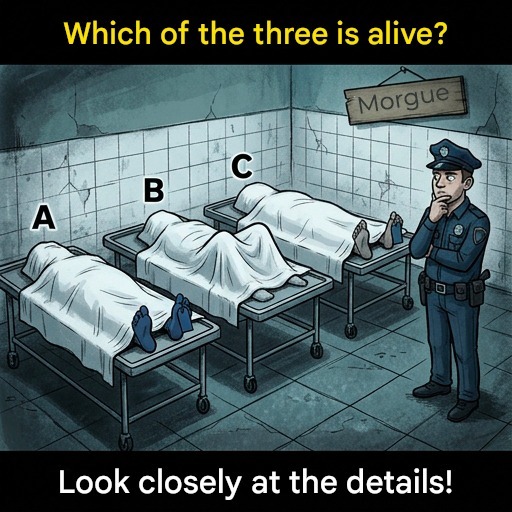
Visual puzzles have fascinated people for generations. A single image can challenge our attention, test our reasoning, and remind us that the smallest details often make the biggest difference.
One popular puzzle asks a simple question:
“Which person is still alive?”
At first glance, the image appears straightforward. Three individuals are shown motionless, and your task is to identify which one is alive based solely on the clues hidden in the picture.
There are no complicated calculations or specialized knowledge required. Success depends entirely on careful observation and logical thinking.
But before revealing the answer, let’s explore why puzzles like this are so engaging and what they actually test.
Why Visual Puzzles Are So Popular
Our brains are naturally drawn to solving mysteries.
When we encounter an unfinished question, our minds instinctively search for an answer. Psychologists sometimes refer to this tendency as the desire for “closure”—we enjoy completing patterns and resolving uncertainty.
Visual puzzles are especially effective because they combine several mental skills at once:
- Observation
- Logical reasoning
- Pattern recognition
- Attention to detail
- Patience
Unlike trivia quizzes, visual challenges don’t depend on memorized facts. Instead, they reward people who slow down and carefully examine what they’re seeing.
Don’t Trust Your First Impression
One of the biggest traps in these puzzles is making a decision too quickly.
Most people glance at the image for only a few seconds before choosing an answer.
That’s exactly what the puzzle is designed to encourage.
Our brains constantly use shortcuts to process information quickly. While these mental shortcuts help us in everyday life, they can also cause us to overlook small but important clues.
The best puzzle solvers resist that impulse.
Instead of guessing, they investigate.
Think Like a Detective
Imagine you’re investigating a mystery rather than solving a game.
Instead of asking, “Who looks alive?” ask yourself:
Next page