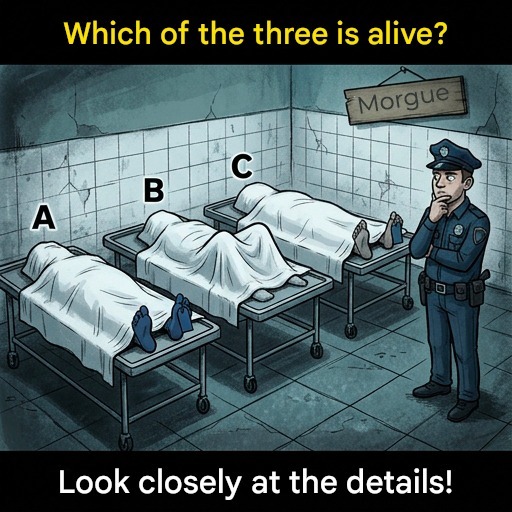
- Is anyone interacting with the environment?
- Is there movement?
- Are there signs of breathing?
- Is anything changing around one person but not the others?
- Does the scene contain clues that aren’t immediately obvious?
Often, the answer isn’t found by looking at the people themselves but by observing what’s happening around them.
The Smallest Details Matter
Many viral visual puzzles rely on tiny clues that are easy to miss.
These might include:
- A shadow.
- A reflection.
- An object being held.
- An animal’s behavior.
- Wind moving clothing or hair.
- Steam or breath.
- Footprints.
- A blinking light.
- Water movement.
Because our brains naturally focus on faces first, we sometimes ignore everything else in the picture.
Yet those background details often contain the real solution.
Why People Disagree
One interesting aspect of these puzzles is how confidently different people defend completely different answers.
This happens because human perception isn’t identical.
Some people naturally notice movement.
Others pay attention to colors.
Some focus on faces.
Others immediately scan the background.
Our experiences influence what catches our attention first.
That’s why two people can study the same image and arrive at different conclusions.
Is There Always One Correct Answer?
Not necessarily.
Some puzzles are carefully designed with one logical solution.
Others are intentionally ambiguous, allowing multiple reasonable interpretations.
On social media, creators sometimes leave clues unclear on purpose because disagreement generates discussion.
The more people argue about the answer, the more likely the post is to be shared.
Common Clues Used in “Who Is Alive?” Puzzles
Although every puzzle is different, creators often rely on similar visual hints.
Examples include:
- Visible breathing on a cold day.
- Eyes that appear open or focused.
- Fresh footprints leading to one person.
- A phone with an active screen.
- A nearby animal reacting to only one individual.
- Recently disturbed objects.
- Movement shown by clothing or hair.
- A hand gripping an object naturally.
These clues encourage careful observation rather than guesswork.
What the Puzzle Really Tests
Despite dramatic headlines, puzzles like this don’t measure intelligence, personality, or psychological traits.
Instead, they primarily test:
Observation
Can you notice details that others overlook?
Patience
Are you willing to examine the entire image before deciding?
Logical Reasoning
Can you connect several small clues into one explanation?
Attention
Can you ignore distractions and focus on relevant information?
These are valuable skills in everyday life as well as in puzzles.
Why Our Brains Miss Obvious Details
Researchers studying attention have shown that people frequently overlook visible objects when concentrating on something else.
This phenomenon is known as inattentional blindness.
A famous psychology experiment asked participants to count basketball passes.
While they focused on counting, many completely failed to notice a person wearing a gorilla costume walking through the scene.
The lesson is simple:
Looking isn’t the same as observing.
Visual puzzles take advantage of this natural limitation.
The Value of Slowing Down
Modern life encourages quick decisions.
We scroll rapidly through social media, glance at headlines, and move on within seconds.
Visual puzzles encourage the opposite habit.
They reward people who pause.
Sometimes the difference between the correct answer and the wrong one is nothing more than an extra ten seconds of careful observation.
Critical Thinking Beyond Puzzles
Although these challenges are entertaining, they also reinforce useful habits.
Careful observation helps us:
- Read information more accurately.
- Avoid jumping to conclusions.
- Evaluate evidence objectively.
- Solve everyday problems more effectively.
The same skills that help solve a visual puzzle can also improve decision-making in work, school, and daily life.
Why These Images Go Viral
Puzzles asking, “Who is still alive?” spread rapidly because they combine several powerful elements:
- Curiosity.
- Mystery.
- Competition.
- Surprise.
- Easy participation.
Anyone can join the conversation regardless of age or background.
People enjoy comparing answers and explaining the clues they noticed.
That interaction keeps the puzzle circulating long after it’s first posted.
Final Thoughts
The challenge of identifying who is still alive isn’t really about finding the fastest answer.
It’s about learning to observe more carefully.
The smallest detail—a shadow, a footprint, a movement, or an overlooked object—can completely change the solution.
Whether you solve the puzzle immediately or need several attempts, the real reward comes from exercising your observation skills and discovering how easily first impressions can be misleading.
The next time you encounter a visual puzzle, resist the temptation to answer immediately.
Take a closer look.
The clue you’re searching for may already be hiding in plain sight.