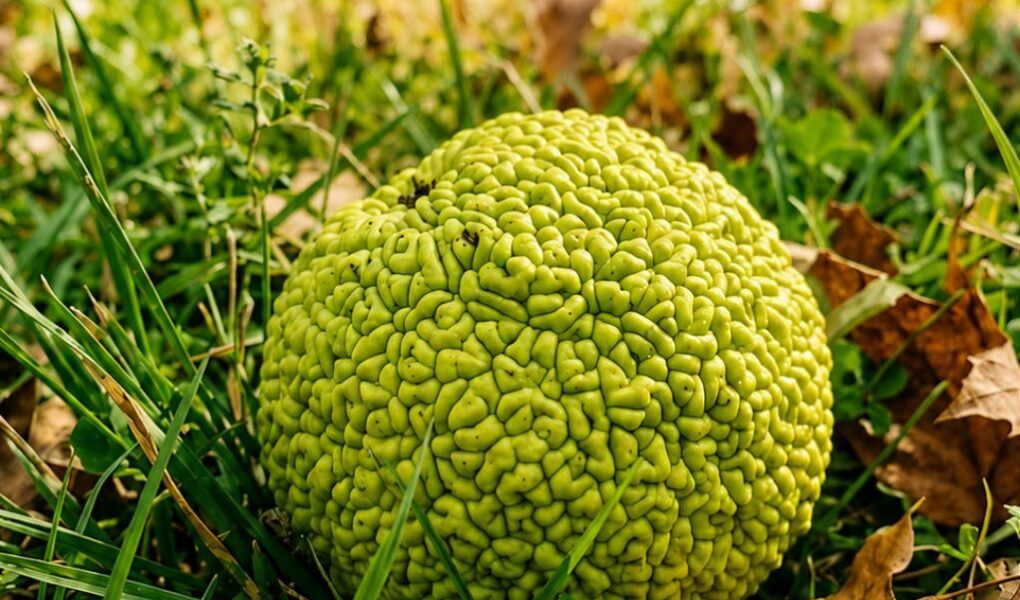
While walking through the yard one autumn afternoon, I noticed something unusual lying beneath a tree.
At first glance, it didn’t even look real.
It was bright green, about the size of a softball, and covered in deep wrinkles that made it look uncannily like a human brain.
Curious, I picked it up.
It was surprisingly heavy and covered with a sticky, slightly tacky surface that immediately made me wonder what I had just touched.
Was it some kind of exotic fruit?
A strange fungus?
A decorative garden ornament that someone had thrown away?
After a little research, I discovered it was something far more interesting—an Osage orange, one of North America’s most unusual fruits.
What Is an Osage Orange?
Despite its name, the Osage orange isn’t actually an orange.
It’s the fruit of Maclura pomifera, a tree native to parts of the central United States.
The tree originally grew across areas including:
- Texas
- Oklahoma
- Arkansas
- Louisiana
Today, however, it can be found throughout much of North America because people planted it extensively over the past two centuries.
The fruit is instantly recognizable thanks to its unusual appearance.
Its deeply folded surface resembles a brain, giving it nicknames such as:
- Hedge apple
- Horse apple
- Monkey ball
- Brain fruit
Although the names vary from region to region, they’re all referring to the same fascinating tree.
Why Does the Fruit Look Like a Brain?
The unusual texture isn’t accidental.
An Osage orange isn’t a single fruit like an apple or peach.
Instead, it’s a multiple fruit, meaning it develops from many tiny flowers that fuse together into one large structure.
Each small section contributes to the wrinkled, bumpy surface.
The result is a fruit unlike almost anything else found in nature.
Why Is It Sticky?
If you’ve ever handled an Osage orange, you’ve probably noticed its tacky surface.
Inside the fruit is a milky, latex-like sap.
When the fruit is damaged or cut open, this sticky sap becomes much more noticeable.
While it may feel unpleasant on your hands, it’s a normal characteristic of the fruit.
Washing your hands afterward is usually all that’s needed.
Can You Eat It?
Technically, the fruit is not considered poisonous to humans, but that doesn’t mean it’s enjoyable to eat.
The flesh is:
Next page