Toss It or Salvage It?
This is where things get a little less black and white. Not every onion that looks imperfect needs to go straight into the trash. Sometimes the outside has simply dried out, while the inside is still perfectly usable. Other times, what looks like a small problem is actually a sign that the onion is breaking down underneath the surface.
The easiest rule is to separate cosmetic changes from actual spoilage.
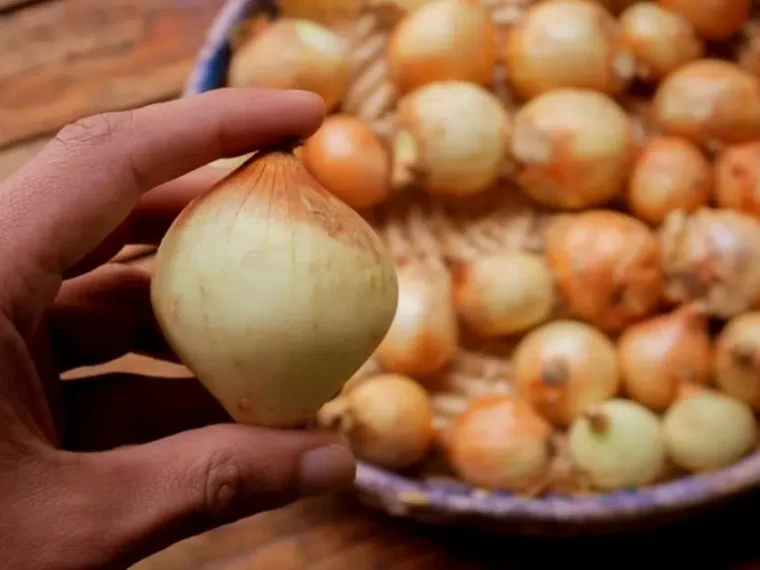
If an onion has a few dry, papery outer layers, peel them away. Those layers naturally become dry and brown as the onion ages, and that alone doesn’t mean the onion has gone bad. Once you’ve removed them, check the flesh underneath. If it is firm, dry, and smells normal, you can use it.
A small area of black mold is a slightly different situation. The USDA’s Food Safety and Inspection Service says that small amounts of black mold on onions can be removed along with the affected outer layers, leaving the unaffected portion available for use. However, people with a known allergy to Aspergillus niger should not use onions affected by this mold.
If the mold is extensive, the onion is wet and collapsing, or several layers are affected, don’t try to rescue it.
What About a Sprouted Onion?
Finding a little green shoot coming out of an onion can be surprising, but sprouting doesn’t automatically mean the onion is rotten.
An onion may start growing when it has been stored for a while. The important question is what the rest of the onion looks and feels like.
If the onion is still firm, dry, and free of mold or unpleasant odors, you can peel it and inspect the inside. You may notice a green shoot developing from the center. The texture can be less pleasant than that of a fresh onion, but the presence of a sprout by itself is not the same thing as soft rot or mold.
On the other hand, if the onion is sprouted and soft, spongy, wet, or decaying, that’s a different story. USDA grading standards identify an onion that has become soft and spongy after sprouting as serious damage.
So don’t judge an onion solely by the little green shoot. Feel the bulb and cut it open if necessary. The condition of the flesh matters more than the fact that it has started growing.
What If Only One Part of the Onion Is Soft?
This is one of the most common situations people run into.
You might pick up an onion that feels firm everywhere except for one small spot. Don’t automatically assume the entire onion is unusable, but don’t ignore the soft area either.
Cut the onion open and inspect the layers around the damaged spot. If the problem is limited to a small area and the surrounding flesh is completely firm, dry, and normal-looking, you can remove the affected section generously and use the remaining onion.
But if the softness extends through several layers, the onion is watery, the flesh has changed color, or there is an unpleasant smell, it’s safer to discard the whole thing.
The same principle applies to bruising. A small dry bruise doesn’t necessarily mean an onion is spoiled. A wet, mushy, leaking bruise is much more concerning because it indicates tissue breakdown.
When in doubt, cut it open rather than relying only on the outside.
Can You Eat an Onion That Smells Strong?
This one can be confusing because onions are supposed to smell strong.
A freshly cut onion naturally has a powerful, sharp odor. That’s completely different from a sour, fermented, musty, or rotten smell.
If you cut into an onion and immediately get the familiar eye-watering onion smell, that’s normal. If you notice an odor that makes you think something is fermented, decomposing, or simply “wrong,” pay attention to it.
Smell is especially useful when combined with other signs. A slightly soft onion that smells normal deserves a closer inspection. A soft, wet onion with a distinctly unpleasant smell is much easier to classify: it’s time to throw it away.
One important safety point: if you see mold, don’t deliberately put your face close to it and sniff it to determine whether it’s safe. USDA guidance advises against sniffing moldy food.
What Happens When an Onion Starts to Rot?
Onion spoilage is often connected with excess moisture and microbial growth. A healthy bulb is firm and relatively dry, while a deteriorating onion can develop soft or water-soaked areas.
The change may begin in one part of the bulb and gradually affect additional layers. That’s why an onion can look reasonably normal from the outside but reveal a problem once you cut into it.
USDA research on onions has found that microbial populations and black mold can be associated particularly with the outer parts of the bulb, including the top, roots, and dry outer scales.
This is also why storing onions in a dry environment matters. Moisture creates conditions that can encourage mold and deterioration.
You don’t need to understand the microbiology to know when an onion has crossed the line. If it has changed from firm and dry to wet, mushy, slimy, leaking, moldy, or rotten-smelling, that’s your practical warning.
How to Store Onions So They Last Longer
The best way to deal with spoiled onions is to prevent them from becoming spoiled in the first place.
Whole bulb onions generally do well when kept in a cool, dry place. The National Center for Home Food Preservation notes that bulb onions store well in a cool, dry location.
Avoid storing them somewhere damp or where condensation frequently forms. A humid environment can encourage deterioration, especially if onions are already damaged.
It’s also a good idea to check your onion basket regularly instead of leaving it untouched for weeks. If one onion becomes wet or starts to decay, remove it before the problem spreads to neighboring produce.
Give your onions enough air circulation rather than trapping them in a damp, sealed environment. The goal is simple: keep whole onions dry and avoid unnecessary moisture.
You can also organize them so older onions are easy to see and use first. That way, you don’t discover a forgotten onion at the bottom of the basket months later.
Should You Refrigerate Whole Onions?
There isn’t one universal storage method that works equally well for every onion and every home. For whole bulb onions, a cool, dry storage area is generally suitable. The National Center for Home Food Preservation specifically describes whole bulb onions as storing well in a cool, dry place.
The USDA also notes that refrigeration can discourage black mold growth on onions and says onions can be stored in the refrigerator for up to two months in that context.
The important thing is to avoid creating condensation or keeping onions in conditions where they become consistently damp.
If your kitchen is particularly warm or humid, refrigeration may be useful depending on the onion and how you’re storing it. Once an onion has been peeled or cut, however, its storage needs are different from those of a whole, dry bulb.
What About Half an Onion?
A leftover half onion is much more vulnerable than a whole onion because cutting exposes the inner tissues to air, moisture, and potential contamination.
Once you’ve cut an onion, place the unused portion in a clean, covered container or suitable food-storage bag and refrigerate it rather than leaving it sitting on the counter.
Before using the leftover piece, check for the same warning signs: excessive softness, slime, mold, unusual discoloration, or an unpleasant odor.
If you regularly end up with half an onion left over from cooking, cutting it into pieces and freezing it is another option. The National Center for Home Food Preservation says diced onions can be frozen without blanching and are best used within a few months.
The texture won’t be the same as a fresh onion after freezing, so frozen onions are particularly useful for cooked dishes such as soups, stews, casseroles, and sautéed dishes.
Don’t Confuse Dryness With Spoilage
One of the easiest mistakes is throwing away an onion simply because it looks old.
An onion’s outer skin is supposed to become dry and papery. You may find several layers that look wrinkled, flaky, or brown before reaching perfectly usable flesh underneath.
That’s not the same as decay.
Think of the outer skin as the onion’s protective wrapping. If the outer layers are dry but the bulb underneath is firm, you can simply peel them away.
The warning signs are what happens underneath: wetness, mushiness, sliminess, spreading discoloration, mold, leakage, or an unmistakably unpleasant smell.
This simple distinction can save perfectly good onions from ending up in the trash while still helping you recognize genuinely spoiled produce.
A Quick Onion Check Before Cooking
If you’re standing in the kitchen wondering whether an onion is still good, you don’t need a complicated test.
Give it a quick inspection:
Look: Is the skin mostly dry and papery? Are there visible mold patches, deep dark areas, or wet spots?
Feel: Is the bulb firm? Or does it feel soft, spongy, slimy, or unusually wet?
Smell: Does it smell like a normal raw onion? Or does it smell sour, musty, fermented, or rotten?
Cut: If you’re still unsure, peel it and cut it open. Check whether the inner layers are crisp and normal-looking or wet and deteriorating.
If all four checks look normal, the onion is probably fine to use.
If several warning signs appear together, don’t try to convince yourself that cooking will fix it. Heat can change the texture and kill some microorganisms, but it isn’t a reliable way to turn visibly spoiled food back into good-quality food.
The Bottom Line
A bad onion usually gives you clues before you cook it. Softness, wetness, slime, mold, dark or mushy flesh, leaking liquid, and an unusual rotten or sour smell are the signs to pay attention to.
Dry, papery outer skin isn’t necessarily a problem. Neither is a small amount of black mold automatically a reason to throw away the entire onion; USDA guidance specifically allows for removing small amounts of black mold from onions and using the unaffected portion, with an allergy-related exception.
But when an onion is heavily moldy, extensively soft, wet, collapsing, or clearly rotten, there’s little reason to take the risk. Throw it away and check the onions that were stored next to it.
And perhaps the easiest habit of all is to check your onion basket every so often. Use the older onions first, keep whole bulbs in a cool, dry environment, and don’t let one forgotten rotten onion sit underneath the others.
Once you get used to checking an onion by sight, touch, smell, and—when necessary—the inside, you’ll know almost immediately whether you’re looking at an onion that’s simply past its prime or one that’s genuinely gone bad.