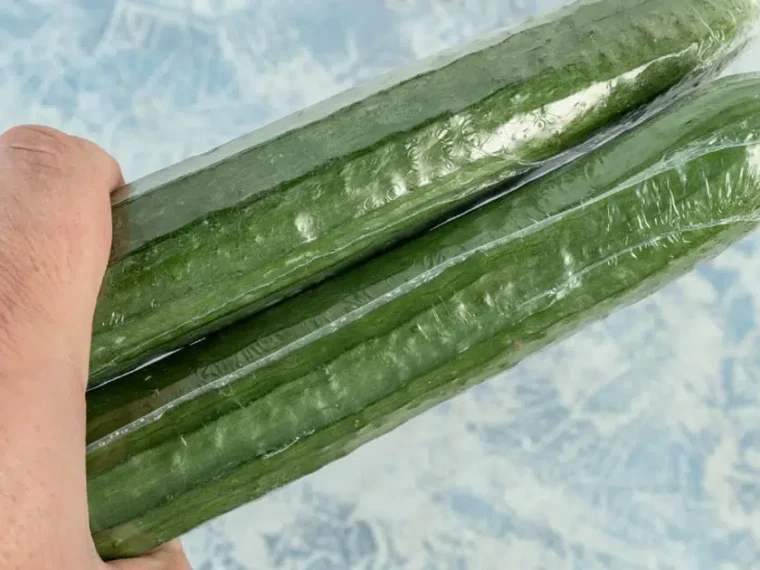
Have you ever walked through the produce section and noticed that English cucumbers almost always seem to be wrapped tightly in plastic?
At first glance, it seems a little strange.
Cucumbers already have a natural outer skin, so why put another layer around them?
The answer has less to do with appearance and more to do with moisture, freshness, transportation, shelf life, and food waste.
That thin layer of plastic is there for a practical reason, although whether it’s the best environmental solution is a much more complicated question.
What Makes English Cucumbers Different?
English cucumbers are also commonly called seedless, European, or hothouse cucumbers, although “seedless” is a somewhat misleading description because they can contain small, undeveloped seeds.
Compared with many conventional field-grown cucumbers, they’re typically longer, slimmer, and have a thinner, more tender skin.
That skin is one of the reasons people like them.
You can generally eat the whole cucumber without peeling it, and the flesh tends to have a crisp texture and relatively mild flavor.
But that delicate skin also means the cucumber is more susceptible to losing moisture.
And that’s where the plastic wrapping becomes useful.
Cucumbers Are Mostly Water
A cucumber contains a very large amount of water.
Once it has been harvested, however, it is no longer connected to the plant that supplied that water.
It continues to exchange moisture with the surrounding environment.
If the surrounding air is relatively dry, water gradually moves out of the cucumber and evaporates.
Over time, the cucumber can become:
- Soft
- Limp
- Wrinkled
- Shriveled
- Less crisp
For consumers, that means an unappealing vegetable.
For a grocery store, it means a product that may no longer sell.
Plastic wrapping creates a barrier around much of the cucumber’s surface, slowing moisture loss.
That can help the vegetable maintain its firmness and appearance for longer.
Why Don’t All Cucumbers Need Plastic?
This is the part that makes the packaging seem confusing.
If plastic helps cucumbers stay fresh, why aren’t all cucumbers wrapped?
The answer is that different varieties have different physical characteristics.
Some traditional cucumbers have a thicker, tougher skin that provides greater protection against moisture loss and physical damage.
English cucumbers are generally grown specifically for their tender skin and eating quality.
The same characteristic that makes them pleasant to eat can also make them more vulnerable to dehydration.
So the plastic essentially acts as an additional protective barrier.
Instead of breeding the cucumber to have a tougher skin, growers and retailers can preserve the delicate skin consumers prefer while using packaging to help protect the vegetable after harvest.
It Isn’t Really “Vacuum” Packaging
Despite the way it may look, English cucumbers are not necessarily vacuum-sealed in the same way as foods such as meat or coffee.
The plastic is usually wrapped tightly around the cucumber to reduce exposure to the surrounding air and, importantly, slow moisture loss.
The exact packaging method varies between growers, packers, retailers, and countries.
So if you see a cucumber covered in tight plastic, it’s better to think of it as protective film rather than automatically assuming it has been vacuum-packed.
The Main Goal Is Longer Freshness
Fresh produce has a limited shelf life.
From the moment a cucumber is harvested, it passes through several stages:
Farm → packing facility → transportation → distribution center → grocery store → consumer
Every step takes time.
During that period, the cucumber needs to remain attractive enough for someone to buy it.
If moisture loss happens too quickly, the vegetable can deteriorate before it reaches the consumer.
The packaging can slow that process.
That is particularly useful for produce traveling long distances.
A cucumber that remains crisp for several additional days is more likely to make it from the farm to the dinner table instead of ending up in a trash bin.
The Plastic Can Also Protect Against Physical Damage
Moisture isn’t the only issue.
English cucumbers have relatively delicate skin, which means they can be more susceptible to scratches, scuffs, and other physical damage during transportation and handling.
The film provides another layer of protection.
It can reduce direct contact with other produce, boxes, shelves, and handling equipment.
That’s important because bruising and surface damage can make vegetables less appealing even when the inside remains perfectly edible.
Grocery stores depend heavily on appearance.
Consumers naturally tend to choose produce that looks fresh, firm, and undamaged.
Does the Plastic Make the Cucumber Safer?
Not necessarily.
This is an important distinction.
The plastic wrapping is primarily intended to help preserve quality and reduce moisture loss.
It should not be treated as a guarantee that the cucumber is free from harmful microorganisms.
Fresh produce can become contaminated during growing, harvesting, processing, transportation, or handling.
The plastic itself isn’t a substitute for proper food hygiene.
Once you bring an English cucumber home, wash your hands before preparing it and follow normal produce-handling practices.
If the package is damaged or the cucumber shows signs of spoilage, don’t assume the plastic has protected it from every possible problem.
Should You Wash an English Cucumber?
Yes.
Even if you plan to eat the skin, it’s a good idea to rinse the cucumber under clean running water before cutting or eating it.
First remove the plastic packaging.
Then wash the cucumber under running water and gently rub the surface with clean hands.
There is generally no need to use soap or household cleaning products on fresh produce.
Washing helps remove dirt and some microorganisms from the surface, although it cannot eliminate every potential contaminant.
Why Not Just Use a Thicker Skin?
You might wonder why growers don’t simply produce English cucumbers with thicker skins.
The answer is that the thin skin is part of the product’s appeal.
Many consumers specifically choose English cucumbers because they don’t have the thick, sometimes bitter skin associated with certain other varieties.
They can be sliced directly into salads, sandwiches, wraps, and other dishes without peeling.
Changing the cucumber itself could therefore change the characteristics consumers are paying for.
Packaging offers a way to preserve those characteristics while reducing the rate at which the cucumber loses moisture.
Does Plastic Actually Reduce Food Waste?
It can.
Research into fresh-produce packaging has shown that packaging can sometimes extend shelf life and reduce food loss, although the results depend heavily on the particular product, packaging system, storage conditions, and supply chain.
This is where the discussion becomes more complicated than simply saying:
Plastic = bad.
Food waste has an environmental cost too.
When a cucumber is thrown away, you’re not only wasting the cucumber.
You’ve also wasted some of the water, fertilizer, energy, land, labor, refrigeration, transportation, and other resources involved in producing and delivering it.
So if a relatively small amount of packaging prevents a significant amount of food from being wasted, there can be an environmental argument in favor of that packaging.
But that doesn’t mean every piece of plastic packaging is automatically environmentally beneficial.
The overall impact depends on the entire life cycle.
The Environmental Problem With Plastic
Of course, the environmental concerns surrounding plastic packaging are real.
Plastic production requires fossil-based resources and energy, and discarded plastic can persist in the environment for long periods.
Plastic waste can contribute to pollution when it isn’t properly managed.
And unlike food waste, a thin plastic film isn’t something that naturally disappears within a short period.
That’s why individually wrapped produce can feel particularly wasteful.
You’re looking at a vegetable that already has a natural protective covering and wondering why it needs another one.
The answer is that the natural skin may not provide enough protection for the specific variety and supply chain.
But the environmental question remains:
Could the same freshness benefit be achieved with less material?
That’s where packaging innovation becomes important.
Could There Be Better Alternatives?
Researchers and food companies have explored numerous alternatives to conventional plastic packaging.
These include:
- Thinner films
- Recyclable materials
- Compostable films
- Reusable packaging systems
- Modified-atmosphere packaging
- Improved storage conditions
- Better supply-chain management
However, every alternative has trade-offs.
A material may be biodegradable but require more energy or resources to produce.
A package may use less plastic but provide less protection.
A recyclable material isn’t necessarily recycled in every community.
That’s why evaluating packaging requires looking at the entire system rather than judging it solely by appearance.
What Happens If the Plastic Is Removed?
If you take the plastic off an English cucumber, nothing dramatic happens immediately.
The cucumber doesn’t suddenly become unsafe or spoil within minutes.
The main difference is that its moisture loss can increase.
How quickly that happens depends on temperature, humidity, air movement, the condition of the cucumber, and how long it has already been stored.
If you’re planning to eat the cucumber soon, removing the packaging at home may not make much practical difference.
If it is going to sit around for several days, however, the protective film may help it remain crisp longer.
How Should You Store an English Cucumber at Home?
Storage recommendations can vary depending on the cucumber, packaging, and refrigerator conditions.
Generally, keep the cucumber cool and follow any storage instructions on the package.
If it is still wrapped, leaving the original packaging intact can help slow moisture loss.
Once opened, you can keep the remaining cucumber protected from excessive drying in the refrigerator.
However, avoid storing it in conditions that are excessively cold for long periods, because cucumbers can be sensitive to chilling injury.
If you’ve ever taken a cucumber out of the refrigerator and found unusual soft spots, watery areas, or texture changes, temperature can be part of the reason.
Why Does the Plastic Sometimes Have Tiny Holes?
You may occasionally notice perforations or tiny openings in produce packaging.
Those aren’t necessarily defects.
Packaging can be designed with specific permeability characteristics to control the exchange of gases and moisture around fresh produce.
Fresh vegetables remain biologically active after harvest.
They continue to respire, consuming oxygen and producing carbon dioxide.
Packaging therefore has to balance several factors rather than simply trapping everything inside.
The exact design depends on the product and packaging system.
Why Are English Cucumbers Often More Expensive?
The packaging isn’t the only factor.
English cucumbers can have different growing requirements, production costs, handling practices, and transportation needs compared with other cucumber varieties.
They are also marketed as a premium product in many stores because of characteristics such as their tender skin, relatively mild flavor, and convenient preparation.
The plastic packaging is just one visible part of the supply chain.
Is the Plastic Safe to Touch the Food?
Food packaging materials are generally manufactured and regulated for their intended food-contact uses in the markets where they are sold.
However, consumers should not assume that every piece of plastic is interchangeable.
Don’t replace the original packaging with random plastic materials and expect identical performance.
If you’re concerned about the packaging, follow the manufacturer’s instructions and local food-safety guidance.
The Real Reason Is More Practical Than It Looks
When you first see an English cucumber wrapped in plastic, it can seem ridiculous.
A vegetable has a skin.
Why does it need another one?
But once you understand what is happening after harvest, the reasoning becomes much clearer.
The thin skin consumers enjoy is relatively vulnerable to moisture loss.
The plastic slows that loss.
That helps the cucumber stay firm, crisp, and visually appealing as it travels from the farm to the grocery store.
And in some circumstances, preserving that freshness can reduce the amount of produce that gets discarded.
Frequently Asked Questions
Why are English cucumbers wrapped in plastic?
The primary purpose is to slow moisture loss and help protect the cucumber from dehydration and physical damage, extending its usable shelf life.
Are English cucumbers naturally seedless?
Not completely. They generally contain smaller and less noticeable seeds than many traditional cucumber varieties, which is why they are sometimes marketed as seedless.
Should I remove the plastic before storing the cucumber?
Not necessarily. Keeping the original packaging intact can help maintain moisture. Follow any storage instructions provided on the package.
Should I wash an English cucumber?
Yes. Remove the packaging and rinse the cucumber under clean running water before eating or cutting it.
Does plastic wrapping mean the cucumber is safer?
No. The primary purpose of the wrapping is preserving quality and reducing moisture loss. It isn’t a guarantee against contamination.
Is individually wrapping cucumbers environmentally friendly?
It’s complicated. Plastic has environmental costs, but preventing food waste can also provide environmental benefits. The overall impact depends on the amount and type of packaging, how much food it prevents from being wasted, and what happens to both the food and packaging at the end of their life.
The Bottom Line
That plastic wrapping around an English cucumber isn’t there simply because grocery stores enjoy using unnecessary packaging.
The main reason is moisture control.
English cucumbers have a thin, tender skin that consumers like, but that characteristic can also make them more vulnerable to dehydration and damage after harvest.
The plastic creates a protective barrier that helps the cucumber retain moisture and remain crisp during transportation, storage, and retail display.
At the same time, the environmental concerns surrounding single-use plastic are completely legitimate.
The most sustainable solution isn’t necessarily as simple as eliminating all packaging. Ideally, packaging should use as little material as possible while preventing enough food loss to justify its environmental cost.
So the next time you see an English cucumber sitting in the produce aisle inside that oddly tight plastic sleeve, you won’t have to wonder why.
That little piece of plastic is essentially acting as a second skin—helping protect the cucumber’s delicate natural skin long enough for it to make its way from the farm to your kitchen.