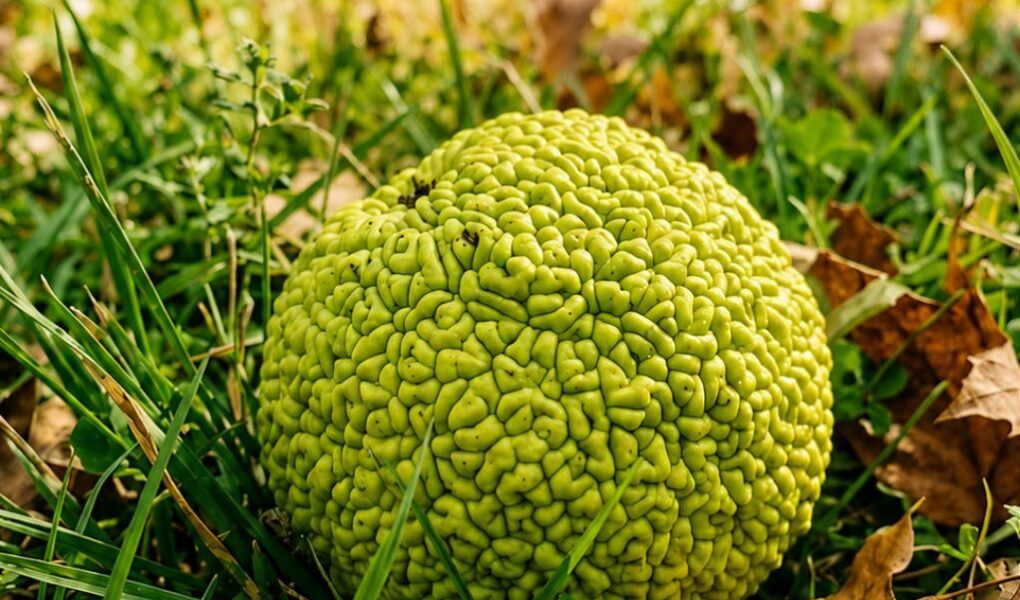
- Extremely fibrous
- Bitter
- Sticky
- Difficult to chew
Most people find it unpalatable.
The fruit also contains numerous seeds embedded within its dense pulp.
Interestingly, some wildlife—including squirrels—often ignore the flesh but eat the nutritious seeds hidden inside.
Who Ate Them in the Past?
One of the most fascinating theories surrounding Osage oranges involves prehistoric animals.
Scientists believe these fruits may have evolved alongside large Ice Age mammals such as:
- Mammoths
- Mastodons
- Giant ground sloths
These enormous herbivores could likely swallow the fruits whole and disperse the seeds over great distances.
When those animals became extinct thousands of years ago, the trees lost many of their natural seed dispersers.
Some researchers describe the Osage orange as an example of an evolutionary anachronism—a species that evolved with animals that no longer exist.
Although the trees continue to survive today, their large fruits seem almost oversized for the animals currently living in North America.
The Tree Is Just as Remarkable
While the fruit attracts attention, the tree itself has an interesting history.
Osage orange trees are known for being:
- Extremely hardy
- Drought tolerant
- Long-lived
- Dense and thorny
Large thorns growing along the branches once made these trees valuable for agriculture.
Before the widespread use of barbed wire, many farmers planted rows of Osage orange trees to create living fences.
Their thick branches and sharp thorns formed barriers that livestock rarely attempted to cross.
These natural hedges became especially popular during the nineteenth century.
One of America’s Hardest Woods
The wood of the Osage orange tree is exceptionally dense and durable.
It has traditionally been valued for:
- Fence posts
- Tool handles
- Furniture
- Woodworking
- Traditional archery bows
In fact, Indigenous Osage people were renowned for crafting powerful hunting bows from this wood.
Its strength, flexibility, and resistance to decay made it highly prized long before European settlement.
Even today, untreated Osage orange fence posts can last for decades.
Do They Repel Insects?
One reason people collect these fruits is a long-standing belief that they repel insects such as:
- Spiders
- Cockroaches
- Crickets
Scientific research has produced mixed results.
Some compounds extracted from the fruit have shown insect-repelling properties under laboratory conditions.
However, simply placing whole fruits around the house has not been consistently shown to prevent insect infestations.
While many homeowners continue the tradition, evidence supporting this practice remains limited.
Why Are They So Common Around Old Farms?
If you’ve noticed Osage oranges growing near abandoned fields or old homesteads, there’s a good reason.
Because farmers once planted them extensively as living fences, many mature trees remain long after the original farms disappeared.
These historic plantings continue producing fruit every autumn.
As a result, people frequently discover the strange green fruits in places where they never expected them.
How to Identify an Osage Orange Tree
The tree has several distinctive features.
Look for:
- Bright green, brain-like fruits in autumn.
- Glossy oval leaves.
- Orange-colored wood beneath the bark.
- Sharp thorns along young branches.
- Rough gray bark on mature trees.
The fruits typically mature during late summer and autumn before falling to the ground.
Should You Pick Them Up?
There’s no danger in handling an Osage orange, although some people prefer wearing gloves because of the sticky sap.
If you collect them, keep in mind:
- They’re quite heavy.
- They can become messy as they age.
- They eventually soften and decompose.
- Their sap may stick to surfaces.
Many people simply leave them where they fall, allowing wildlife to feed on the seeds and nature to recycle the fruit.
A Reminder of Nature’s Creativity
The Osage orange is a perfect example of how surprising the natural world can be.
At first glance, it looks almost artificial—a strange green object that seems more suited to a science fiction movie than a backyard.
Yet its unusual appearance reflects millions of years of evolution and a fascinating ecological history tied to animals that disappeared long ago.
What seems bizarre today once played an important role in ancient ecosystems.
Final Thoughts
Finding a mysterious green “brain” in your yard might be startling at first, but chances are you’ve discovered an Osage orange—one of North America’s most distinctive native fruits.
Although it’s not a fruit most people would want to eat, its unusual appearance, remarkable tree, durable wood, and connection to prehistoric wildlife make it one of the most interesting plants you’ll encounter.
The next time you spot one beneath a tree, you’ll know you’re looking at much more than a strange piece of fruit.
You’re holding a small reminder of North America’s natural history—one that has puzzled, fascinated, and inspired curiosity for generations.