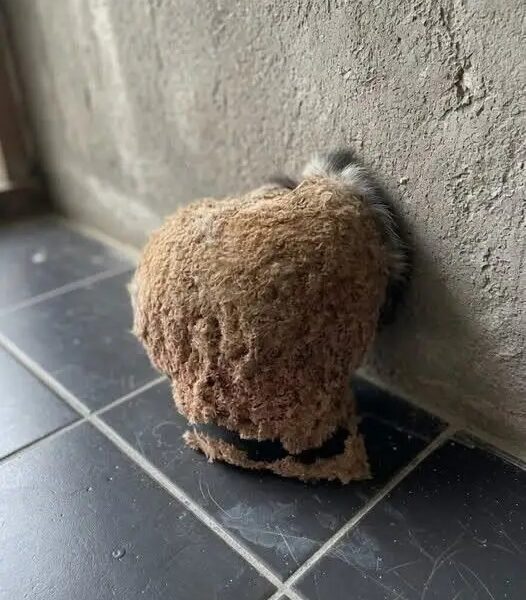
Many people assume wasps only build nests outdoors.
While trees, sheds, roof eaves, and porches are common locations, paper wasps sometimes choose indoor spaces when they find a way inside.
Bathrooms can be particularly attractive because they often provide:
- Warm temperatures
- Quiet corners
- Moisture
- Protection from wind and rain
- Very little disturbance
If a window or vent was left slightly open before the family left on vacation, a queen wasp could easily have entered and begun construction.
How Quickly Can They Build?
One surprising fact is how fast paper wasps work.
A single queen begins building alone.
She creates the first few paper cells herself before laying eggs inside them.
Once the larvae hatch and develop into adult workers, nest construction accelerates dramatically.
In only a week or two, what began as a tiny structure can become much larger.
That’s why the family didn’t notice anything before leaving—but returned to find a clearly visible nest.
Are Paper Wasps Dangerous?
Finding a wasp nest inside your home can certainly be alarming.
Fortunately, paper wasps are generally less aggressive than yellowjackets.
They usually sting only when:
- Their nest is disturbed.
- They feel threatened.
- Someone accidentally touches or traps them.
Still, caution is important.
For individuals with allergies to insect stings, even one sting can become a medical emergency.
It’s always best to avoid handling an active nest directly.
What Should You Do If You Find One?
If you discover a small wasp nest inside your home:
Stay Calm
Most wasps are more interested in protecting their nest than chasing people.
Avoid sudden movements around the area.
Identify the Insects
If wasps are actively entering and leaving the nest, keep your distance.
Different insects require different removal methods.
Avoid Spraying Immediately
Randomly spraying chemicals without understanding the situation can agitate the insects.
If the nest is active and difficult to access, professional pest removal is often the safest option.
Seal Entry Points
After the nest has been removed safely, inspect your home for:
- Gaps around windows
- Damaged screens
- Vent openings
- Small cracks
Preventing future entry is often easier than dealing with another nest later.
Nature’s Incredible Engineers
Although finding one inside your bathroom isn’t ideal, paper wasps are extraordinary architects.
Their nests demonstrate remarkable engineering.
Each tiny hexagonal cell is carefully measured and constructed.
The paper-like material is both lightweight and durable.
Scientists have long studied insect nests for inspiration in architecture and materials science.
It’s fascinating to realize that such a complex structure can be built by creatures only a few centimeters long.
Why These Discoveries Fascinate Us
Objects like this capture people’s imagination because they remind us that our homes are constantly interacting with nature.
Even modern houses are part of a much larger environment.
Birds search for nesting sites.
Spiders spin webs.
Bees explore flowers.
Wasps look for sheltered corners.
Sometimes, when we’re away for only a few days, nature quietly begins moving in.
A Vacation Surprise No One Expected
The family later admitted that, although the discovery initially startled them, it became one of the most memorable parts of returning home.
What first appeared to be a mysterious object turned out to be an impressive example of insect engineering.
It also served as a reminder to check windows, vents, and quiet corners before leaving home for extended trips.
Sometimes the smallest discoveries become the most unforgettable stories.
Final Thoughts
Finding an unfamiliar object attached to your bathroom wall can certainly be surprising.
In many cases, however, the explanation is much simpler than it first appears.
Paper wasps are skilled builders capable of creating intricate nests in surprisingly short periods of time, especially in quiet, sheltered areas.
If you ever return home to discover a similar gray, paper-like structure tucked into a corner, resist the urge to poke it with your finger.
Take a closer look from a safe distance first.
You might not be looking at a strange piece of paper at all—but at one of nature’s most remarkable construction projects.